


Even if you’re not desi or Eurasian, you’ll have come in touch with the concept of who or what aunties are. Another attempt at writing more personal essays. There will be typos. I’m Amrita, and welcome to my personal column. It’s free and it always will be.
The summers in that town and in that flat I told you about, were unbearable. You would not have found air conditioning in a hovel housing students, so we kept every door and windows flung open until bedtime, in the name of cross-ventilation.
Two young women sharing a flat are, on their own, reason enough for families—and for older women especially—to raise an eyebrow and give their ears a good clean. But that we stayed up awake till late, or went out late and come home later still, was genuinely newsworthy to them. And that we had male friends over—group work mates, dates, college juniors to tutor—was cause enough for outright scandal.
Where are their parents? Do their parents know boys are walking in and out of the flat at all odd times and constantly?
Our parents, being college-educated and “modern” in some workable sense of the word, knew. They knew. They were the ones who had encouraged us to step out of the world we’d grown up in and into the unknown of college in a whole new state or a whole new country, to study and learn and widen our circles. They could not have cared less whether Ajay, Rajesh, Sunny, Dev were hanging out in our apartment, bent over the drawings until two in the morning and then crashed out among them, in their three-day-old clothes until ten.
It was not unusual to step out into the communal hallway and catch the floating head of an aunty vanishing around the front door of her own home. Clearly spying and speculating right up until we opened our front door. Or to go open the windows that overlooked the shared courtyard and find an aunty trying to peer into our rooms from a floor above. In time, they stopped trying to hide and we stopped trying to be private. Creepy, yes. Unusual, no.
In the little paddock of desi life, aunties are inevitable. Aunties are unavoidable. We let them wag their tongues and work themselves up while we ignored their gaze and simply lived our lives. They hated being ignored, which we suspected was, quite possibly, exactly what was happening in their own domestic lives, though we didn’t know for sure, as we at twenty-one scoffed mercilessly and with unearned confidence at domesticity in all of its form.
One aunty once walked into our living room uninvited. No, you read that correctly. No knocking or ringing the bell, not even a small “hello” lobbed through the doorway. She lived two floors up and had never managed to get a clean line of sight to our windows or front door, and so, clearly scandalised by the scene we’d left in plain view—the front door left open in the heat and six of us, three boys and three girls, working, chatting, snacking and laughing together—she marched right in, hands on her hips in and demanded to know what was going on.
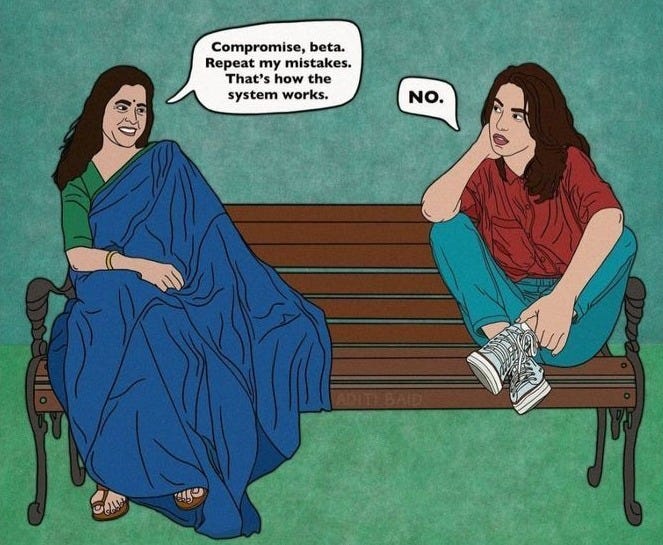
We stared at her for a second. It was beyond our capacities to understand what had given her the right to walk in without permission. But then I found my voice, and especially my sharp tongue with it, and asked her what her problem was and who let her in. I was, admittedly, aiming to be rude. I asked the questions, eyed her slowly up and down and walked her back through the open door and into the lobby she’d come from. Made it a point to slam the door on her horrified face. She may have gathered we were students and the spread of industrial sized stationery may have clued her into where or what we studied, because very soon the floating heads and roving eyes lessened. Did not disappear, only lessened.
Not all of them had the nerve to breach the front door, of course. Most preferred to escalate through the proper channels. My mother. Which initially proved to be tricky because my mother lived in a different state altogether and sometimes we even had several countries between us, and the aunties barely knew my name let alone my family history.
By a stroke of luck, my mother visited me in Baroda one summer, and the aunties watched us go in and out of the building from the peepholes on their doors. One afternoon, one of them found herself in the elevator with us. She took great exception to the fact that I would, on a hot night, cross the road at midnight in my pyjamas to fetch ice cream from the store directly opposite to the building (a journey of some forty feet). She took the opportunity if using the elevator ride to deliver this grievance to my mother with real ceremony.
My mother, an ungovernable woman who has never once in her life been managed by an aunty, heard the whole complaint out, and then said, sweetly, “I’m relieved she’s crossing the road for ice cream and not for something worse like financially motivated exchanges of the carnal kind. Thank God I’ve raised her to know the difference.”
The aunty had no follow-up, because how could there be a follow-up to that.
An aunty is not a fixed category of person. It is like matter, maybe. Like ice or steam. The temperature at which one sets or evaporates is lower or higher than anybody warns you. And I know this because I am increasingly conscious of the fact that I am becoming one. I have caught myself becoming one. A cyclist runs a corner and I hear a sound leave my body that is pure aunty, a wet tch of the tongue. I see a girl out in January in a vest, and something in me genuinely wants to tell her she'll catch her death. I also have thoughts about other people's posture and dating checkboxes, about the volume of other people's music on trains. I now say when I was young. I have started catching it mid-flight.
Then there are aunties-from-across-the-streets of a different practical disposition. When I moved back to London, I found myself a humongous house in Ealing which was rotting away, because its owner had been claimed by Covid and her two sons, both living abroad, had no idea what to do with the empty house. It was a corner terrace, three storeys, like a lived in museum stopped dead in time. No one had lived in it for seven months. But the refrigerator had been left running with an old cup of yogurt in it, something wrapped in aluminium foil, the freezer had ready meals and ice, the TV turned on to Channel 4 at a considerable volume, and the plants had been watered by the neighbour apparently. There were pots and pans left out, as though someone had dashed to grab something from the cornershop in the middle of cooking a meal and simply never came back.
After about six months there, I was moving to somewhere that was closer to work. On a sunny Saturday morning I locked the house up, handed the keys to the next-door neighbour, and as I waited for my cab on the kerb amidst an armada of IKEA bags and suitcases packed past their dignity, an elderly woman dressed in a boubou that pooled around her feet, ran-limped up to me from across the street.
“Are you leaving?” she asked. I squinted into the sun and wondered whether a question that intrusive from essentially a stranger, deserved an answer. But I’d seen her a few times at her kitchen window before and I did just watch her hobble the whole way out of her house to ask me this question.
I said yes. Tried to make it sound like both an agreeable answer and a confused one at the same time.
“It’s sad, what happened to their mother,” she said.
I hadn’t known the boys’ mother, but I knew what had happened to her.
“Did you know her well?” I asked.
She did. Friends, even. My taxi was maybe three minutes out when she gave me a look and said, “You know I waited up for you.”
“I’m sorry?” I said, unsure.
“I waited up. I’d see you leaving for work so early in the mornings, all bouncy, and then get back home so late, all droopy and tired. And then your returns got later and later, and this—” she moved her arm along the length of the road, “—the road gets so dark, there are no streetlights up and down. So I waited up every night to make sure you got home.”
I blinked, because what else was there to do. That a stranger had been waiting up night after night to see me get home safely without my knowing or ever having asked, was like having an actual guardian angel who left no indication of their existence.
The aunty is a surveillance system nobody installed and nobody can switch off. It’s intrusive and runs on a data policy of pure vibes and zero consent. It is also the last working piece of infrastructure that assumes your business is somebody else’s business. The state will not wait up for you. The app that tracks your taxi does not care whether you get out of it. The building has cameras, and the cameras have footage, and not one of them has ever once wondered whether you’d eaten. An aunty wonders. An aunty has always already wondered, and formed a view, and decided how to tell your mother.
I spent my twenties desperate to be unobserved. Being watched at twenty-one is a cage. At forty, I would still not like to be watched or have to entertain nosy souls drilling their ways into our lives. I would like them to knock and ask for permission.
But I would like to be kept count of.
I would like, very much, to be waited up for.
And I would someday like to leave my own kitchen light on, a little later than I need to, for a bouncy girl down the road who leaves early and comes home dragging, and who does not know I am there, and does not need to.
Happy writing!
Amrita
Such a lovely ending 😇 enjoyed this